

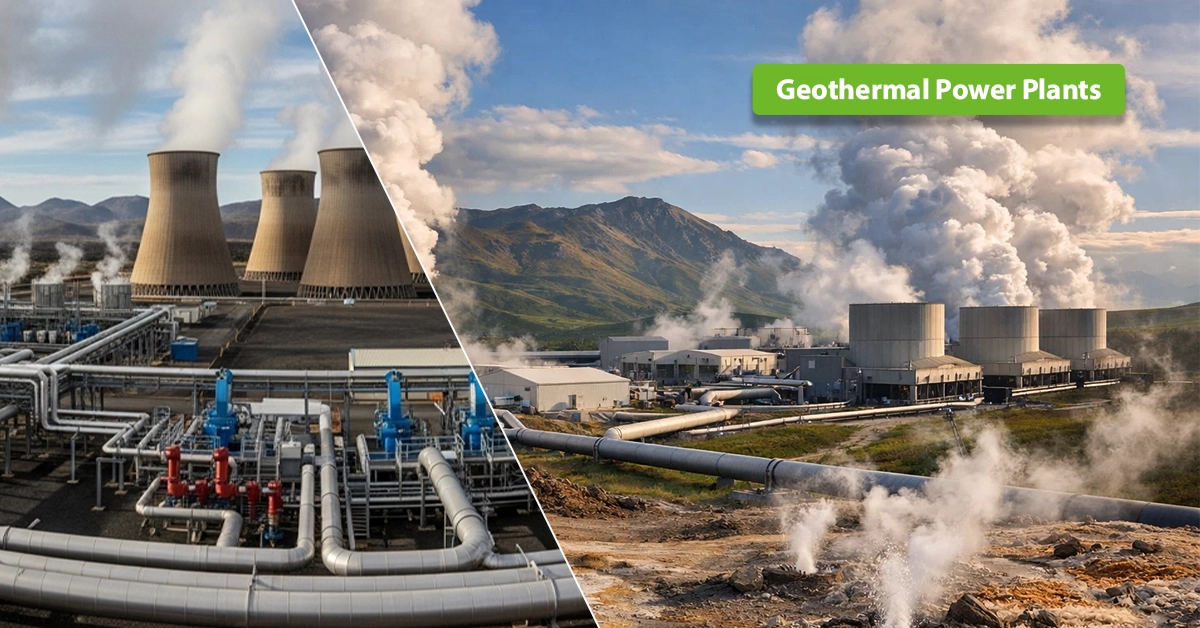
Geothermal energy is a thriving internal market, and it is harnessed through dedicated power plants. Let’s understand how geothermal power plants operate to convert Earth’s core heat into electricity at scale.
Key Takeaways
- Geothermal power plants are used to convert Earth’s underground heat into electricity through steam-driven turbines.
- Binary cycle power plants are expanding rapidly due to near-zero emissions and wider geographical feasibility.
- Geothermal energy provides reliable baseload power with very high capacity factors.
- Future innovations like supercritical geothermal and reusing wells that were initially dug for oil and gas can significantly expand global adoption.
What Is a Geothermal Power Plant?
A geothermal power plant is an establishment that extracts thermal energy from a geothermal reservoir and converts it into electricity. The reservoir has a natural, permeable rock formation that accumulates water and heat.
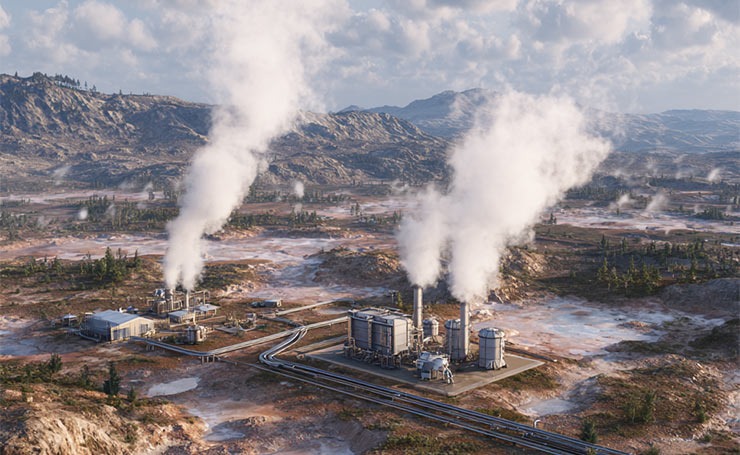
While solar panels and wind turbines harness energy from the atmosphere, geothermal power plants tap into what is already stored beneath the Earth’s surface.
The US is the world’s largest producer of geothermal energy, particularly in California, Nevada, and Utah, which lie on active zones.
How Does a Geothermal Power Plant Work?
Geothermal power plants generate electricity through a clear sequence of steps. However, these details may vary depending on the type of power plant.
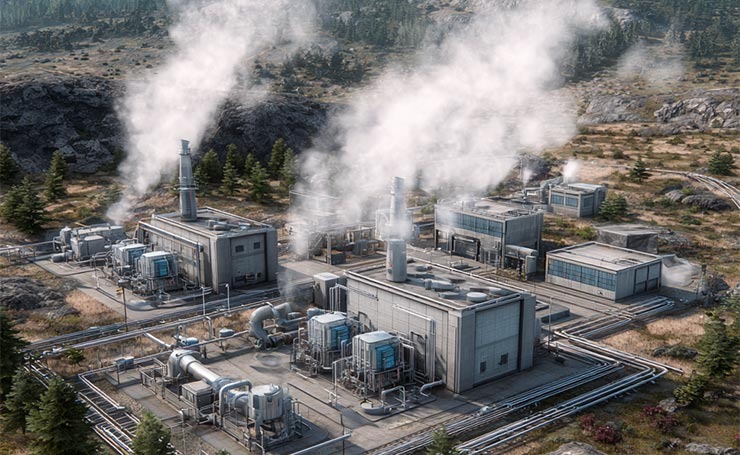
Important Infrastructure Components
The key components of a geothermal power plant infrastructure include
- Wellheads
- Steam separators
- Turbines
- Generators
- Condensers
- Cooling towers
- Injection wells
The Complete Electricity Generation Process
The process starts with production wells drilled into a geothermal reservoir, sometimes as deep as 1500 to 3000 meters. Underground hot water or steam rises naturally to the surface due to the pressure differential between the reservoir and the surface. At the wellhead, operators control flow and direct the fluid towards the plant’s processing system.
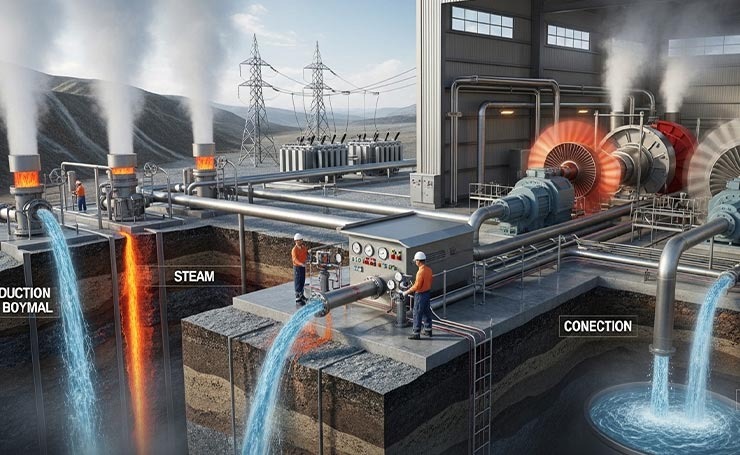
Then the steam is either extracted directly or separated from the hot water. It is directed to a turbine. The steam’s kinetic energy rotates the turbine blades, and that rotational force starts the generator, converting mechanical motion into electric current. The electricity then goes through transformers and into the grid.
After passing through the turbine, the hot water or steam is cooled in a condenser, where it is converted back into liquid. This cooled fluid is reinjected into the ground through injection wells, where it reheats and can be extracted again. This cycle makes geothermal energy sustainable because the fluid is continuously recycled.
Types of Geothermal Power Plants
The type of power plant used depends on the temperature and the state of geothermal liquid at a particular location.
Dry Steam Power Plants
Dry steam plants are the earliest and most basic type, first used in 1904 in Italy. They operate at high pressure, where geothermal reservoirs produce steam directly, with no liquid water mixed in. The steam is piped straight from the reservoir to the turbine.
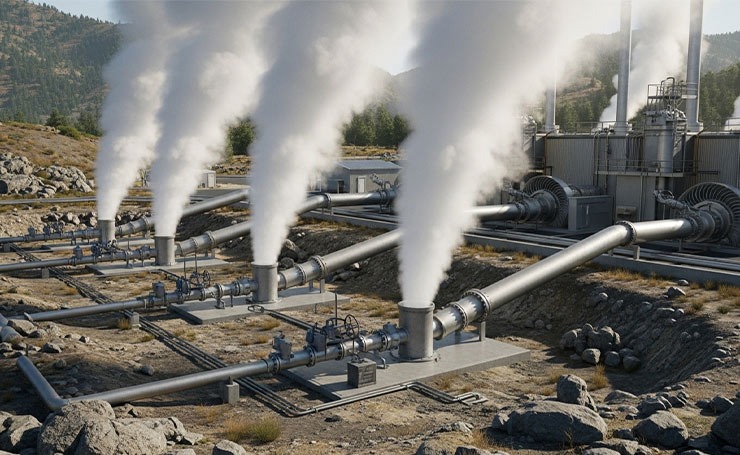
However, the limitation is geological. Dry steam reservoirs are rare in the world; they cannot be expanded. The most common example is The Geysers in Northern California.
Flash Steam Power Plants
These power plants are most common globally because they use high-temperature water rather than dry steam.
When this pressurized water comes to the surface, it is sent to a flash tank where pressure rapidly reduces. This sudden pressure drop causes water to flash (instantly vaporize into steam). This steam is directed to a turbine. The remaining liquid is either reinjected into the ground or sent to a second flash stage.
Double-flash systems add a second flash tank that further reduces water pressure to create steam. In this way, the same fluid volume is used for increased electricity output.
Flash power plants operate in the US, the Philippines, Kenya, and Iceland.
Binary Cycle Geothermal Plants
Binary cycle plants solve the problem that the above-mentioned power plants cannot: what to do when fluid in the reservoirs is warm but not hot enough to produce steam efficiently. These plants use water temperatures as low as 100°C and sometimes even lower.
Binary power plants use a heat exchanger to produce electricity. The hot water passes through it, and on the other side of that exchanger, there is a secondary working fluid like pentane or isobutane. This fluid has a much lower boiling point than water.
The geothermal heat vaporizes this secondary working fluid, which then spins the turbine. The two liquids never mix. They only exchange heat.
These power plants are the fastest-growing type because they operate on moderate temperature resources that are more available geographically than high-temperature reservoirs.
Comparison at a Glance
| Feature | Dry Steam | Flash Steam | Binary Cycle |
| Reservoir Temp | > 150°C (often 200°C+) | > 182°C (360°F) | 74°C to 182°C |
| Fluid Type | Steam only | High-pressure liquid water | Moderate-temp liquid/brine |
| Global Prevalence | Rare | Most common | Fastest growing |
| Surface Emissions | Moderate to High H2S | Moderate to High H2S | Near Zero (Closed Loop) |
| H2S Management | Required (Abatement) | Required (Abatement) | Inherently managed |
| Best Use Case | Vapor-dominated fields | High-temp liquid reservoirs | Lower-temp resources |
Geothermal Reservoirs: The Foundation of Power Generation
A geothermal reservoir is only useful when it has three things.
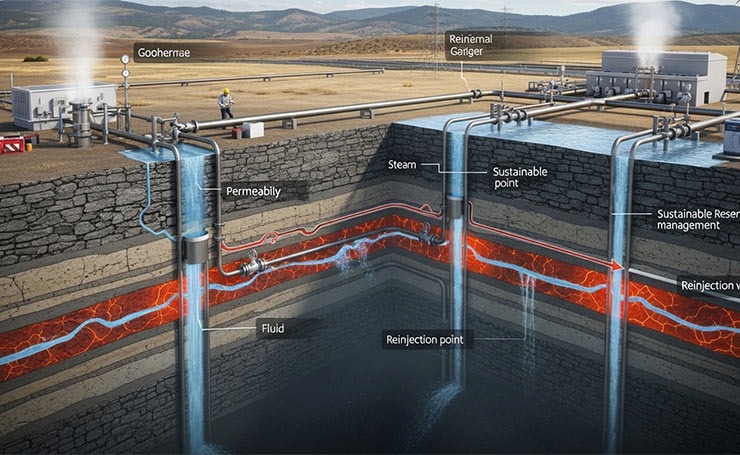
- Sufficient heat
- Water
- Permeability
Temperature alone is not enough. The hot, impermeable rock prevents fluid flow, making extraction impractical.
The US Energy Information Administration (EIA) and the US Geological Survey (USGS) evaluate geothermal resources by mapping subsurface temperatures, heat flow rates, and fluid chemistry across different locations. These assessments show where plants can be developed and which type is most suitable.
Reservoir management is what determines whether a plant remains productive over its operational lifetime, which is 25 to 30 years or more. Operators monitor the reservoir and ensure to reinject cooled liquid at calculated rates to maintain pressure.
The Geysers experienced a significant decline in output in the 1980s when extraction exceeded the reinjection rate. It required a major reinjection program that used treated municipal wastewater to recover.
Capacity Factor and Plant Performance
One of the major benefits of geothermal energy is its capacity factor, which measures how often a power plant runs at full power.
Geothermal plants achieve the capacity factors of 80 to 95% consistently. By comparison, solar runs at 25% and wind turbines run at 30 to 40%. This difference is important for grid planning. For instance, a 100 MW geothermal plant delivers 100 MW of energy 24/7 every day of the year. A 100 MW solar farm delivers the same result but only during the peak sun hours.
This makes geothermal one of the few renewable technologies capable of serving baseload power, which means constant electricity generation that keeps the grid stable. It also eliminates the dependency on backup storage.
Key Players in the US Geothermal Power Industry
The following are the most important entities in the US geothermal industry.
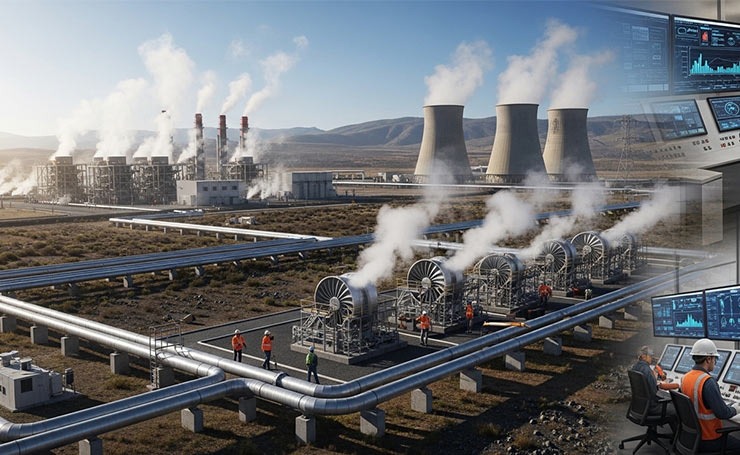
Ormat Technologies
Ormat Technologies is one of the most prominent developers and operators of binary cycle geothermal power plants globally. It designs, builds, and operates its own parts and works in different regions, including the US, Kenya, Guatemala, and several other countries.
Calpine Corporation
Calpine Corporation owns and operates The Geysers in California, which is the world’s largest geothermal installation by capacity. It can produce over 700 MW of energy under optimal conditions.
The US Energy Information Administration (EIA)
EIA has a different role. While it does not build or operate plants, it tracks and publishes geothermal capacity data, resource assessments, and generation statistics.
Geothermal Power Plant Economics
Geothermal plants are expensive to develop and cheap to operate. While long-term operation is affordable, the real barrier is the entry.
Drilling is the most expensive upfront. It accounts for 30 to 50% of total development expense. Moreover, a single production well can be around $5 to $10 million, depending on depth, geology, and location. These projects require multiple production and injection wells before operations begin.
Another challenge is exploration skill. Sometimes a reservoir may underperform even after significant drilling investment.
Once operational, however, geothermal plants have low and predictable costs. They do not need fuel or combustion equipment and can run with minimal staffing.
Environmental Footprint of Geothermal Power Plants
Compared to fossil fuels, geothermal plants are remarkably clean. But the specific environmental footprint varies by plant type.
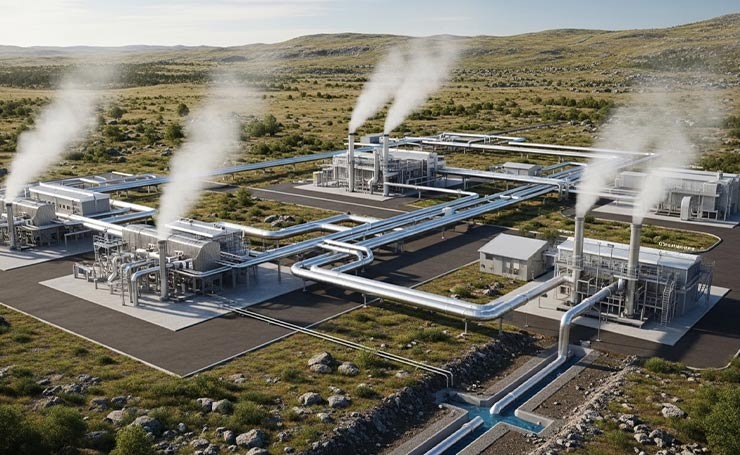
Binary cycle plants: These are the cleanest in terms of air emissions. As geothermal fluid circulates in a fully closed system, there are no gas emissions except for water vapor during maintenance operations.
Flash and dry steam plants: These plants require more attention to hydrogen sulfide management. H₂S occurs naturally in many geothermal fluids and has a distinct sulfur odor. Modern plants use abatement systems to capture and neutralize it before venting.
On land use, geothermal power plants use less surface area, unlike utility-scale solar or wind farms. This is why geothermal is suitable for areas with constrained land.
Moreover, fluid management is also carefully controlled in all plant types. Reinjection prevents dissolved minerals, trace metals, and thermal pollution from reaching surface water systems, making closed-loop geothermal one of the lower-impact forms of electricity generation.
The Future of Geothermal Power Plants
The next generation of geothermal development looks promising.
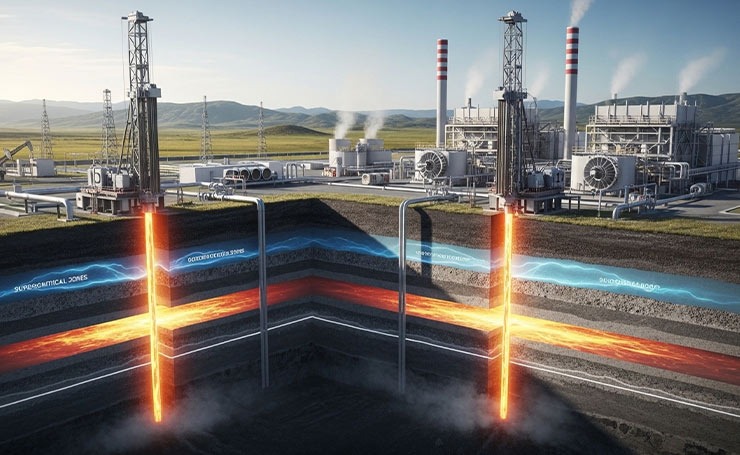
Supercritical Geothermal
It is one of the leading concepts that corporations are working on. Around 4 to 5 kilometers underground, water exists in a supercritical state, where it behaves neither as a liquid nor as a gas. However, it carries 5 to 10 times more energy per unit volume than traditional hydrothermal fluid.
Iceland’s IDDP project is exploring this concept, and if harnessed commercially, this system can significantly increase energy output as well.
Repurposing Oil and Gas Infrastructure
It is also getting serious attention. The United States has thousands of wells drilled into deep, hot rock for oil and gas operations. The good news is that many of these reach temperatures sufficient for binary cycle generation.
Adapting these existing wellbores for geothermal activities reduces the drilling costs and opens up development in states that have oil and gas histories, such as Texas, West Virginia, and Oklahoma.
Growth Projections
The EIA’s projection suggests US geothermal electricity capacity could grow substantially through 2050, particularly with EGS expansion (to know more about EGS, read this blog). Some analyses show geothermal capacity growing several-fold from current levels, driven primarily by next-generation technologies.
Final Thoughts
Geothermal power plants represent one of the most consistent and reliable clean energy technologies. They do not depend on weather, run continuously, have small land footprints, and emit minimal emissions. However, the only limitation is geographical constraints, which EGS and next-generation drilling are eliminating.
Learn more about sustainable energy on Green Energy Insights.
FAQs
How do Geothermal Power Plants generate Electricity from Underground Heat?
Geothermal power plants dig deep wells to access hot water or steam and use it to spin turbines. Then they reinject the cooled water into the ground to sustain the cycle.
Why is drilling the most expensive part of Geothermal Power Plant Development?
Deep drilling requires advanced equipment, geological expertise to find the right site, and multiple wells. This is why it is the most expensive part of geothermal power plant development.
How do Geothermal Power Plants manage hydrogen sulfide (H2S) emissions safely?
Modern geothermal power plant facilities use the abatement method, in which they capture and neutralize hydrogen sulfide before releasing it in the atmosphere.
Why are Binary Cycle Geothermal Power Plants considered the cleanest option?
They are considered clean because they operate in a closed loop, which prevents gas emissions and keeps geothermal fluid contained. This entire process results in near-zero air pollution.
