

20-Second Summary
Is natural gas a renewable resource? The simple answer is no. Natural gas is a nonrenewable energy source from fossil fuels, with a major percentage of methane gas, and it contributes to greenhouse gases.
In this guide, we will explore the following information about Natural Gas:
- How oil, natural gas, and natural gas deposits are extracted and widely used around the world
- What are its real-world use cases, including electricity generation from processed natural gas
- The environmental impact, including natural gas leaks, releasing natural gas, air pollutants, less carbon dioxide than burning coal, and other pollutants
- Alternative renewable energy resources compared to natural gas renewable options
- How natural gas can be converted into green energy
- Whether natural gas reserves and natural gas wells will be depleted in the upcoming years
- What humans expect regarding the use and depletion of this vital energy resource
The Truth About Natural Gas
As we have already answered that natural gas is not renewable, but there are many factors due to which it gets misunderstood as a renewable resource.
Why People Think Natural Gas Might Be Renewable
- The terminology “Natural Gas” confuses many people because it has the word natural included in its name, which shows that it might be renewable.
- People find this cleaner than other CO2-emitting energy resources like burning coal, hence consider it renewable and clean.
- Some people consider it renewable, thinking it’s made from organic materials, without having proper education on its formation and its greenhouse gas emissions.
- The Renewable Natural Gas is being produced using waste materials, which is being misunderstood for natural gas by many people who confuse the two.
- Because domestic natural gas reserves and natural gas wells are large and easy to access, people may mistakenly think the supply is unlimited, like renewable resources.
Why This Debate Matters for Energy Today
Natural gas is being widely used across the world, both commercially and domestically, from natural gas wells to processed natural gas in electricity generation. However, it is formed from fossil fuels and contains methane gas, which makes it an energy resource that can impact our environment, despite being an efficient way of getting heat and energy.
- This is the major reason why there is a huge debate around its usage, whether natural gas is renewable, and finding ways to discover more natural gas reserves.
- At the same time, there is a growing focus on how natural gas is extracted in an environmentally friendly way, reducing natural gas leaks, air pollutants, carbon monoxide, and other pollutants.
What Natural Gas Really Is and Why It Matters Today
Natural gas is a fossil fuel having methane in its major composition (70%-90%), along with other gases in its main composition like Butane, Ethane, and Propane.
It also has some other components, including: Water vapors, Nitrogen, Hydrogen Sulfide, Carbon Dioxide, and trace amounts of gases like oxygen and Helium.
The reason why this Energy resource matters a lot today is due to
- It is a naturally occurring, affordable energy source
- It burns cleaner than oil or coal (Other fossil fuel energy sources)
Why Natural Gas Is Part of the Fossil Fuel Family
Natural gas, like the other fossil fuels, coal, and oil, is a part of the fossil fuel family because it has been formed from organic materials.

- The dead remains of organic matter, buried under rock layers, were subjected to high pressure and heat for millions of years, turning them into natural gas and oil.
- During this process, hydrogen atoms and carbon atoms combine to form methane gas, the main component of natural gas.
- These natural gas deposits are tapped through natural gas wells, and the gas is extracted for commercial and domestic use.
Renewable vs Nonrenewable Resources: How Natural Gas Fits
Understanding how natural gas is formed clarifies why it is nonrenewable and distinguishes it from renewable vs nonrenewable resources, which we will be discussing later in the blog.

But before moving towards that, below is a table that gives you five reasons why an energy resource can be both a fossil fuel and non-renewable, and it also gives another column stating how and why Natural gas ticks that box and is seen as both a fossil fuel and non-renewable energy source.
| How a Resource is Fossil Fuel and Nonrenewable | How does Natural Gas fit this? |
| Formed from ancient organic material over millions of years | Natural gas explained: formed from plant and animal remains under rock layers and high pressure |
| Takes millions of years to replenish | Natural gas deposits are finite; extraction from natural gas wells and gas wells depletes reserves faster than formation |
| Contains carbon atoms and hydrogen atoms (hydrocarbons) | Composed mainly of methane gas (one carbon atom + four hydrogen atoms), making it a fossil fuel |
| Produces greenhouse gas emissions when burned | Processed natural gas for electricity generation releases carbon monoxide, less carbon dioxide than coal, but still contributes to air pollutants |
| Extraction requires significant industrial effort | Natural gas is extracted through drilling, fracking, and laying pipelines from natural gas reserves and sometimes from the ocean floor |
The Long Journey of Natural Gas Formation and Its Types
As we all know, natural gas takes millions of years to form. Let us take a look at how it actually happens in a multi-step process, scientifically.
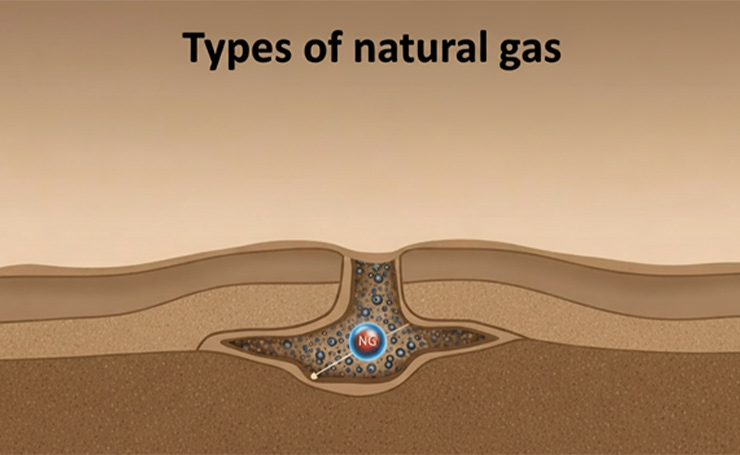
- Usually, it begins with the decomposition of organic materials like plants, animals, and Plankton that get mixed with the ocean floor sediment.
- With passing years, and for millions of years, these keep getting buried deeper with more sediment, causing more pressure and heat on the remains, converting them into a greasy-like material called the Kerogen.
- Even with the formation of Kerogen, the temperature keeps increasing further, due to which the kerogen itself breaks down during this process, which is named the “Thermal maturation.”
- Upon breaking down the kerogen, it forms hydrocarbons. The lightest hydrocarbons formed in this process are called natural gas, with different components in it, including methane, which comprises 70% to 90% of the natural gas.
- Natural gas is then stored under the rocks formed above them, and these reservoirs are extracted by man-made technology for its consumption.
Different Types of Natural Gases
Yes, natural gas can exist in different types, and can be formulated into different types for transportation and consumption means as well.
Natural Gas Types in their Natural Composition
Based on its natural composition, it can be of these types:
- Dry gas: A mixture with a high concentration of methane and very few natural gas liquids (NGLs). This gas is great for electricity generation and use commercially.
- Wet gas: A mix of methane with a significant amount of other NGLs, such as ethane, propane, and butane. This gas is extracted from natural gas wells.
- Sweet gas: Natural gas that is low in hydrogen sulfide. This type is used domestically and is safer for the processing plants.
- Sour gas: Natural gas that is rich in hydrogen sulfide. This gas cannot be used without being processed in a processing plant.
- Shale gas: A type of unconventional gas that is trapped within layers of shale sedimentary rock. Drilling and Fracking are used to get access to this type of gas.
Natural Gas Types Based on Conversion for Easy Transportation
Natural gas is also converted into Liquefied natural gas or compressed natural gas for easy transportation, or to use as a fuel for transportation.
- Compressed Natural Gas (CNG): Natural gas that has been compressed to take up less volume, primarily used in vehicles.
- Liquefied Natural Gas (LNG): A form of natural gas that has been super-cooled to turn into a liquid for easy storage and transportation. This gas is also used in the generation of electricity.
How Extraction Works in the Real World
Natural gas is extracted through its reservoirs using different extraction methods, and then it is sent to the plants to purify it and convert it into a usable form of gas that is shared with the end users, like power plants and homes, using pipelines.
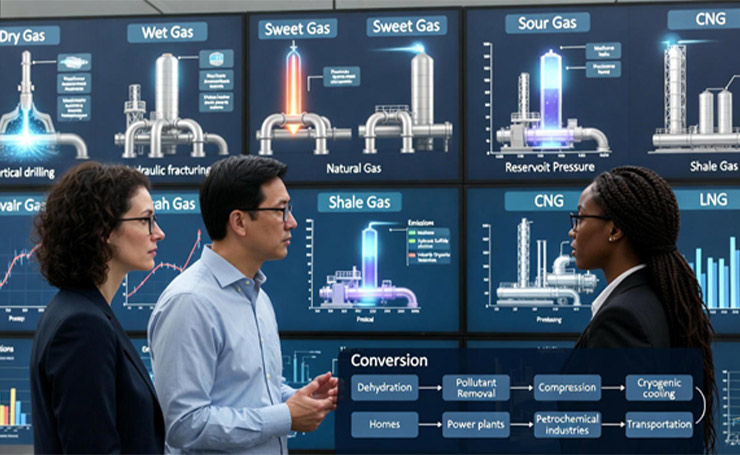
The different natural gas extraction methods being used are given below, along with their purification process, the emissions that occur during the whole process, and their application in real world.
| Natural Gas Type | How It Is Extracted | Harmful Gases Released During Extraction | How It Is Converted Into Usable Gas | Main Applications |
| Dry Gas | Extracted from deep underground reservoirs using vertical or horizontal drilling. | Methane leaks during drilling and the release of natural gas from rock layers. | Sent to a processing plant for dehydration and removal of other pollutants. | Homes, commercial heating, and electricity generation. |
| Wet Gas | Extracted from natural gas wells through drilling and reservoir pressure release. | Methane, ethane, and other hydrocarbons escape during gas handling. | Processed to separate NGLs and convert the methane-rich gas into pipeline-quality fuel. | Power plants, petrochemical industries, and commercial use. |
| Sweet Gas | Collected through conventional drilling in reservoirs low in hydrogen sulfide. | Methane leaks during extraction but fewer toxic air pollutants. | Light processing for moisture removal and compression before laying pipelines. | Domestic heating, cooking, and small industries. |
| Sour Gas | Extracted through drilling but always routed to specialized processing plants. | Releases hydrogen sulfide and methane, which are harmful to air quality. | Treated at a processing plant to remove hydrogen sulfide and carbon dioxide before distribution. | Industrial facilities, power generation after purification. |
| Shale Gas | Produced through horizontal drilling and hydraulic fracturing in shale rock layers. | Methane leaks, volatile organic compounds, and other pollutants from high-pressure fracking. | Processed to remove water, sand, and impurities before entering storage tanks or pipelines. | Electricity generation, industrial boilers, and commercial use. |
| CNG | Created by compressing natural gas extracted from conventional gas wells. | Methane emissions during compression and storage tank handling. | Compressed at high pressure to form CNG for vehicles and local pipelines. | Transportation fuel, local distribution networks. |
| LNG | Created by cooling natural gas at liquefaction plants after extraction. | Methane slip during cooling, transfer, and storage. | Super cooled into a liquid and stored in cryogenic tanks for transport. | Export shipping, large power plants, and industrial heating. |
The Hidden Environmental Cost of Natural Gas
While natural gas has been widely used all over the world, it still poses many threats to our environment that have been briefly explained below.
Methane Leaks and Their Climate Impact
Methane is the major component in the composition of natural gas, and it has the tendency to leak during the process of the extraction of natural gas, and is not visible to the naked eye.
It not only leaks during the extraction process, but it also leaks during its processing and transportation, releasing huge amounts of methane into the environment, causing more CO2 availability in the air.
Carbon Emissions from Burning Natural Gas

Although natural gas does not emit as much carbon dioxide as the other fossil fuels like coal and oil do while burning, it still releases CO2 while burning, which is a greenhouse gas, causing the greenhouse effect.
- While natural gas produces less CO2 than coal when burned, methane leaks during extraction, processing, and transport can offset this benefit.
- Recent research shows that even small leaks can make the natural gas harmful to the climate as much as coal over a 20-year period.
This means natural gas’s “cleaner” reputation depends on keeping methane leak rates exceptionally low, something current industry practices struggle to achieve.
Air, Water, and Land Pollution from Extraction
- As already explained, the extraction and combustion of natural gas emit both methane gas and CO2, which pollute the air.
- It is also a known fact that during the extraction of the gas, several other air pollutants like Nitrogen oxides, Sulfur oxides, and Hazardous air pollutants are also emitted that can impact the lives of the societies living near these gas extraction sites, causing respiratory issues, along with many other health-related issues.
- During the extraction of natural gases with procedures like hydraulic fracturing, the use of large amounts of water causes saline water waste and may contaminate the groundwater upon contact with it.
- Local water resources in the water-scarce areas can be depleted.
- Naturally occurring radioactive materials can be brought to the surface in wastewater, causing an increased radiation exposure risk for workers.
- Building well pads, access roads, and pipelines requires clearing land, which fragments and destroys habitats for wildlife.
- The release of pollutants can affect soil and land health.
Is Natural Gas Sustainable for Future Supply?
Although natural gas is being widely used as an energy source around the globe, and it is considered to be clean than other non-renewable resources, we are still very much aware that the natural gas extraction process and its supply chain process, including its final use to produce energy, do leak methane gas and emit CO2 while combusting.
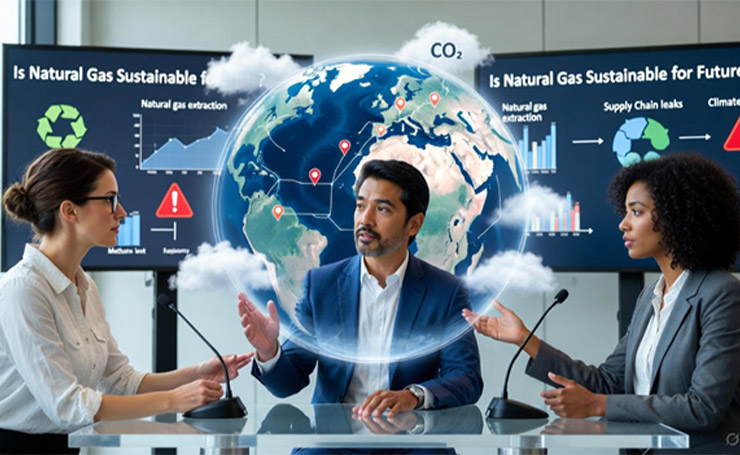
Sustainability of the natural gas is still in question, as the natural gas and climate change are both linear, and the latter is impacted by the natural gas, making the future of the natural gas supply possible, but requiring research to work on methods that can make it less dangerous to the environment.
Natural Gas in the Energy Transition
Natural gas is known as the bridging fuel, as it takes up the place of energy generation when renewable resources like the sun, wind, and water stop working. However, most energy experts predict natural gas phaseout will occur well after 2040, potentially not until 2050 or later, depending on renewable energy adoption rates and policy implementation globally.
With more environmental awareness, people are now supporting the use of renewable energy sources, and not just that, global policies are now heavily adopting the renewable energy resources, which might be replacing all the non-renewable energy sources, including natural gas.
The cost-effectiveness of natural gas compared to other energy sources might be playing a major role in its adoption, but that might also change as the other renewable sources take up a major portion of the world’s energy supply, turning into affordable and never-ending energy sources.
Natural Gas vs Renewable Energy: Cleaner Alternatives That Are Replacing Natural Gas
When it comes to the comparison between natural gas and renewable energy sources, the major difference is that the former will deplete over time, but the latter will not.
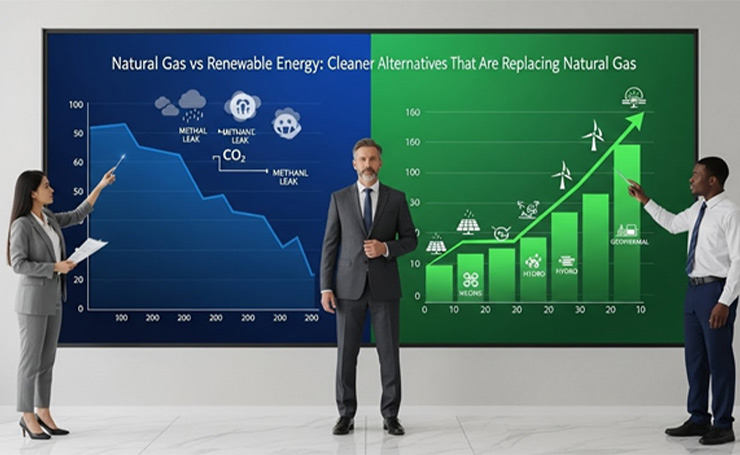
With more natural awareness, there are many renewable alternatives that are now not only being used worldwide, but are sought to replace natural gas in the coming future, with a proper infrastructure to use them as the basic means of energy creation.
Let us have a look at some major renewable energy resources that can replace natural gas, and how they differ from it.
| Natural Gas | Renewable Energy Resources |
| Originated naturally by decomposition | Naturally replenished |
| Depleting source | Inexhaustible |
| Emits greenhouse gases | Little to no greenhouse impact |
| Examples include natural gas with different elements like methane, nitrogen, etc. | Solar energy, Wind energy, Hydropower, and Geothermal power. |
Final Remarks
Natural gas is indeed a widely used naturally occurring energy resource, but despite being less costly and cleaner in emitting CO2 while combusting as compared to other fossil fuel energy sources, it still poses severe negative impacts on the environment and population.
Despite its being a questionable energy source due to the methane gas leaks, CO2 emissions, land, water, and air pollution, many people still support its continuing use based on several factors, including:
- Multiple uses in different industries, transport, and for domestic use.
- The role it plays for developing countries is providing low-cost energy where needed.
- It provides clean-burning energy compared to other fossil fuels.
- It’s enhanced energy stability to reduce reliance on different energy sources.
- Some developing nations fear depending more on developed nations due to a ban on natural gas that could stifle their economic growth.
If we have to comment on whether it is a safe source of energy consumption or not, the review in our blog states it clearly, but with advanced technology, we do have the hope to convert the natural gas into more sustainable and zero-emission energy.
For more Green Energy Insights and recent updates on different renewable and non-renewable sources, keep visiting our website.
Frequently Asked Questions
Is natural gas a renewable resource?
No, natural gas is nonrenewable because it forms over millions of years in deep rock layers and natural gas deposits, so it cannot replenish like renewable energy sources.
What makes natural gas a nonrenewable energy source?
Natural gas takes millions of years to compose deep under rock layers, so once we take it out of natural gas wells, it cannot be replaced quickly.
Why is natural gas classified as a fossil fuel?
It is created from old organic matter like dead remains of plants and animals, just like oil and coal, making it part of the fossil fuels group used for electricity generation and heating.
Is natural gas cleaner than coal?
When burned alone, natural gas produces fewer CO₂ emissions than coal. But the methane gas leaks during the extraction and transport of the natural gas can offset this benefit and make it as harmful to the climate as coal over a 20-year period.
What are the most reliable alternatives to natural gas?
Solar, wind, geothermal, renewable natural gas, and hydropower are other alternatives to natural gas.
